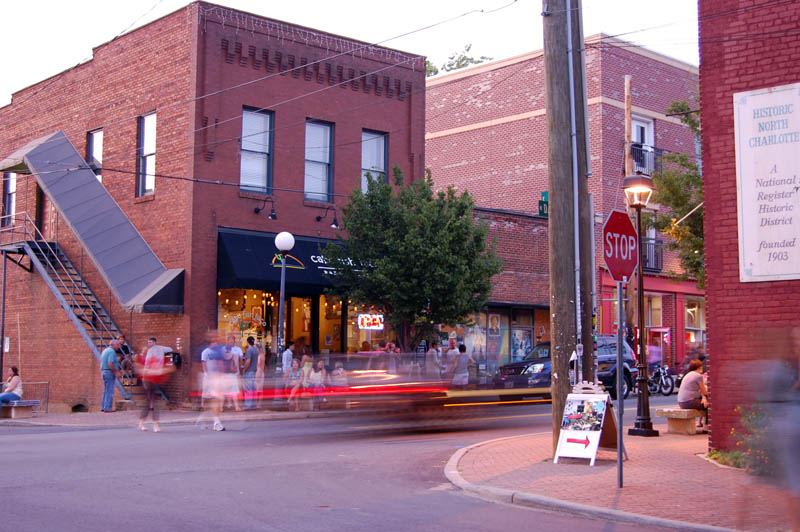

| Address | Roughly bounded by the Southern Railroad, Herrin St., Spencer St., and Charles Ave., Charlotte |
|---|---|
| Architectural style | Bungalow/Craftsman |
| National Register | ref 90000367, listed 1990-03-16 |
| Research depth | dossier, independently sourced |
What we established, and from where
The North Charlotte Historic District takes in three former textile mills, two former mill villages, a business district and a small group of middle-class houses, some 438 resources in all.
independent National Park Service / NC SHPO · checked 2026-09-18
Before the mills arrived the area was rolling Piedmont farmland, and the County Poorhouse stood on what is now East 36th Street.
independent National Park Service / NC SHPO · checked 2026-09-18
Street names on the western side of the district commemorate the mill executives Jesse S. Spencer and Charles Worth Johnston.
independent National Park Service / NC SHPO · checked 2026-09-18
The street names Warp and Card come from stages of the textile manufacturing process.
independent National Park Service / NC SHPO · checked 2026-09-18
The Highland Park Manufacturing Company bought about 103 acres of rolling farmland three miles north of downtown Charlotte in 1903.
independent National Park Service / NC SHPO · checked 2026-09-18
Highland Park Mill No. 3 was by a wide margin the largest textile factory in Mecklenburg County, with over 100,000 square feet given over mainly to making gingham.
independent National Park Service / NC SHPO · checked 2026-09-18
Highland Park Mill No. 3 was designed by Stuart W. Cramer, whose 1906 book Useful Information for Cotton Manufacturers showcased its plans and specifications.
independent National Park Service / NC SHPO · checked 2026-09-18
All three of North Charlotte's mills ran on electricity, which allowed more flexible and innovative mill designs.
independent National Park Service / NC SHPO · checked 2026-09-18
The L-shaped, two-storey brick and timber main plant had a pneumatic system that blew cotton from the warehouse straight into the plant.
independent National Park Service / NC SHPO · checked 2026-09-18
Cramer isolated the mill's stairways inside brick towers as a fire precaution.
independent National Park Service / NC SHPO · checked 2026-09-18
Cramer designed the large mill village that went with Highland Park Mill No. 3 as well as the mill itself.
independent National Park Service / NC SHPO · checked 2026-09-18
The Mecklenburg Mill opened in 1905, a quarter of a mile north-east of Highland Park Mill No. 3.
independent National Park Service / NC SHPO · checked 2026-09-18
In 1919 the Mecklenburg Mill worked 14,048 spindles and employed 175 operatives making gingham.
independent National Park Service / NC SHPO · checked 2026-09-18
No mill village was ever built for the Johnston Mill; its workers lived in housing scattered around the edges of northern Charlotte.
independent National Park Service / NC SHPO · checked 2026-09-18
The Grinnell Company factory in the district made sprinkler systems and fire extinguishers used in textile mills across the South, including the district's own three mills.
independent National Park Service / NC SHPO · checked 2026-09-18
Both Highland Park Mill No. 3 and the Mecklenburg Mill were fitted with sprinkler systems made in the neighbourhood.
independent National Park Service / NC SHPO · checked 2026-09-18
North Davidson Street, running parallel to the railway, carried the streetcar line connecting North Charlotte to downtown.
independent National Park Service / NC SHPO · checked 2026-09-18
The commercial area was first included in the Charlotte city directory in 1929.
independent National Park Service / NC SHPO · checked 2026-09-18
The 1904 Hand Pharmacy Building is the most architecturally significant commercial building in the district.
independent National Park Service / NC SHPO · checked 2026-09-18
The two-storey Lowder Building of 1927 stands across the street to the south and survives largely intact.
independent National Park Service / NC SHPO · checked 2026-09-18
A 1920s gable-front concrete-block building in the district began life as an ice station and was converted to a petrol station in the 1930s.
independent National Park Service / NC SHPO · checked 2026-09-18
The 1936 fire station appears to be a smaller, one-bay version of the two-bay stations built in Charlotte in the late 1920s by the leading city architect C. C. Hook.
independent National Park Service / NC SHPO · checked 2026-09-18
Spencer Memorial Methodist Church was razed in the early 1950s, when the North Charlotte YMCA was built on its grounds.
independent National Park Service / NC SHPO · checked 2026-09-18
North Charlotte Primary School operated until the 1920s, when a larger brick-veneered school was completed north of Spencer Memorial Church.
independent National Park Service / NC SHPO · checked 2026-09-18
The Highland Inn was an integral part of Stuart Cramer's original plan for the Highland Park village and may have been designed by Cramer's practice.
independent National Park Service / NC SHPO · checked 2026-09-18
The primary source
The National Register nomination is the fullest account of this property that exists, written by a researcher and reviewed by the State Historic Preservation Office. The nomination (National Park Service).
Browse from here
all 6 Bungalow/Craftsman buildings · all 201 listed places in Charlotte
Where this comes up
Other Bungalow/Craftsman buildings on the register
- Billingsville School
- Sidney and Ethel Grier House
- Pineville Mill Village Historic District
- VanLandingham Estate
- Wesley Heights Historic District