
Elmwood, Pinewood and Potter's Field
The City of Charlotte bought the land in 1853, when Settlers Cemetery on West Fifth Street — until then the city's first and only municipal burial ground — was running out of room.
What the city created was not one cemetery but three, on one hundred acres:
- Elmwood, for white residents
- Pinewood, for African American residents
- Potter's Field, for those who could not afford a plot
The Charlotte-Mecklenburg Historic Landmarks Commission's own survey report puts the arrangement plainly:
"the separation of black and white graves into two completely segregated cemeteries (Elmwood was white, Pinewood, black, physically separated by a chain fence) made the Elmwood Cemetery complex the center of a controversial local civil rights campaign during the late 1960s."
A chain fence, through a graveyard, until the late 1960s. The three are now administered as a single cemetery of about seventy-two acres on the 700 block of West Sixth Street.

Who is buried there
The survey report names, among many thousands:
- Edward Dilworth Latta, who developed Dilworth — the neighbourhood that carries his middle name
- D. A. Tompkins, the textile entrepreneur whose company built mills across the city
- S. S. McNinch, a former mayor of Charlotte
- W. W. Smith, described by the report as Charlotte's first Black architect
That last name is worth pausing on. W. W. Smith designed the Mecklenburg Investment Company Building in Brooklyn — financed by Black professionals in 1921–22 as the first office building in Charlotte open to them, and one of the very few Brooklyn buildings to survive urban renewal. The man who built it is buried on the segregated side of the city's municipal cemetery.
Old Settlers' Cemetery
On West Fifth Street in Fourth Ward — Charlotte's first municipal burial ground, and the reason Elmwood exists. It stopped being able to take the city's dead.
Visiting
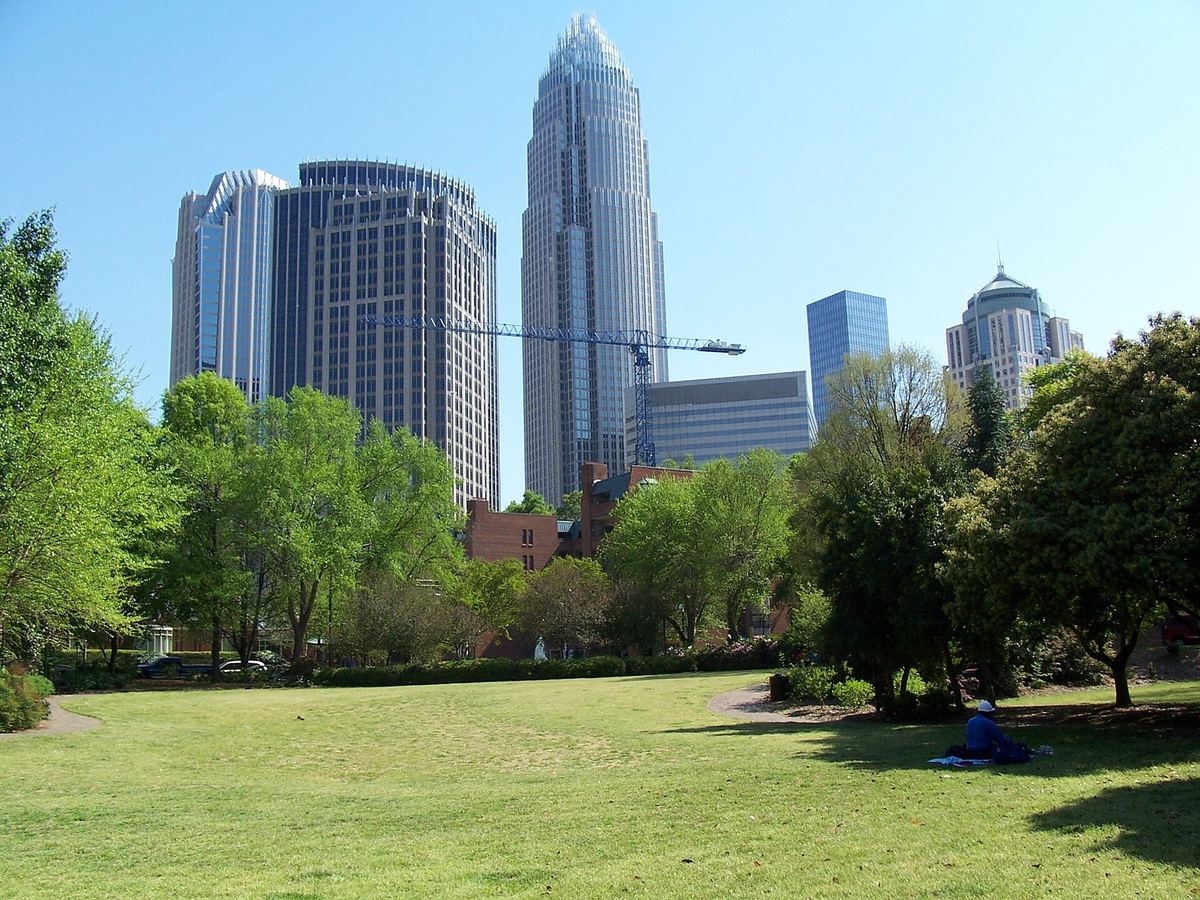
A volunteer organisation, Historic Elmwood Pinewood, publishes virtual tours of all three cemeteries, runs a "Voices from the Past" programme and a 5K, and describes the grounds as Uptown's largest public green space — with, in its own words, families picnicking among some of the city's finest specimen trees.
These are working cemeteries and active burial grounds. Visit as you would any other: quietly, on the paths, and not during a service.
Tours, events and current access are on their site.
Places on this page, in detail
- Settlers Cemetery · Cemetery
Read next
Local landmark or National Register? What the labels actually mean
If you have looked into an old Charlotte building you will have met both phrases, often on the same…
Who designed Charlotte: the planned suburbs
Drive through Dilworth, Myers Park or Elizabeth and the streets curve where a developer working to a…
Dilworth
Dilworth was laid out for Edward Dilworth Latta, and it kept his middle name. The National Register of…
NoDa (North Charlotte)
NoDa is short for North Davidson, the street it grew up along. The name is recent; the place is not. On…
The Historic West End
West of Uptown, around the campus of Johnson C. Smith University, is a network of neighbourhoods that…
University City
Charlotte's north-eastern quarter is organised around a university, a boulevard and a rail line, and…