
It is older than that, and the reason is metal.
The Charlotte-Mecklenburg Historic Landmarks Commission's own survey work quotes the historian Thomas Hanchett on the point directly:
"Two events lifted Charlotte out of its minor place on the periphery of the plantation economy . . . the discovery of gold in 1799 and the coming of the railroad in 1852."
Gold came first. And because of it, in 1836, a town of a few hundred people acquired a branch of the United States Mint.
It started with a doorstop
The discovery was not in Charlotte. It was about twenty miles east, in Cabarrus County, on a farm beside Little Meadow Creek.
North Carolina Historic Sites — the state agency that operates the site today — tells it like this. John Reed, born Johannes Reith, was a Hessian soldier who left the British army near the end of the Revolutionary War and settled among fellow Germans in the lower Piedmont, farming corn and wheat like everyone around him.
One Sunday in 1799, his son Conrad found a large yellow rock in the creek. It reportedly weighed 17 pounds. For three years it held open a door at the Reed house.
In 1802 a Fayetteville jeweller recognised what it was and bought it for the price Reed asked — $3.50. The agency states plainly what that was: one-tenth of one percent of its true value.

And then Peter found a bigger one
In 1803 Reed formed a mining partnership with three local men. The arrangement, as the state agency describes it, was this: the partners supplied the equipment and the enslaved men who dug the creek bed; Reed supplied the land; the returns were split equally. They worked it in the off-season, after the crops.
Before the end of that first year, an enslaved boy named Peter unearthed a 28-pound nugget.
North Carolina Historic Sites describes it as the largest documented gold nugget found in the United States — the largest ever found at Reed, and the largest found east of the Mississippi.
The gold rush that followed, the branch mint in Charlotte, the fortunes it made: it runs through that one boy, whose surname nobody recorded.
What the rush actually looked like
Once word spread, Piedmont farmers started working their own creeks. The state agency notes that men and women, young and old, worked the gold fields, and that skilled Cornish miners came from England to join them.
The easy phase was placer mining — panning and washing creek gravel. In 1825 it was learned that gold also sat in veins of white quartz underground, and that changed the economics entirely: lode mining needed capital, labour and machinery. Underground work at Reed itself did not begin until 1831, and four years later a family dispute produced a court injunction that shut the mine for a decade.
At its peak, the agency states, gold mining was second only to farming in the number of North Carolinians it employed, with recovered gold valued at over a million dollars a year. North Carolina led the nation in gold production until 1848, when California ended that.
John Reed died a wealthy man in 1845. The mine was sold at auction soon after.
The Charlotte connection at the end of the story
Reed's last serious run came after 1895, when Dr Justin D. Lisle and Oliver S. Kelly and his son O. Warren Kelly bought the property for $15,000. By 1896 they had installed a ten-stamp California-style mill on Little Meadow Creek — bought, the agency records, from the Mecklenburg Iron Works of Charlotte.
By then the relationship had reversed. The gold had built Charlotte's industry; now Charlotte's industry was equipping the gold.
The Kellys deepened the Upper Hill workings to 150 feet. The gold they hoped for never appeared, and they ended underground mining in 1912.
The last big nugget, and an argument the state publishes against itself
In April 1896 four men digging near an old road found a rock they nearly threw away. Washed off in the creek, it turned out to be a 23-pound nugget — the last large one reported from Reed. Plaster casts went to the N.C. State Museum and the Smithsonian. The nugget sold for $4,800.
The site interprets it as the Shinn nugget, after Jacob L. Shinn. But North Carolina Historic Sites publishes the objection on its own history page: some descendants of the Cox family say A. M. "Mack" Cox actually found it in the ground, and the period photograph of the nugget names A. M. Cox, not Shinn, as the discoverer.
We have reproduced that dispute rather than tidying it, because the agency did.
The Mint
Gold needed somewhere to become money. Before the federal government stepped in, gold in this part of the state circulated as privately struck coins stamped "Bechtler", made at a private mint in Rutherfordton.
In 1836 the Charlotte Mint opened — the first branch of the United States Mint, and one that specialised in gold coinage. Up to 600 mines are reported to have operated in Mecklenburg County, with the principal source inside the city being the Rudisill Gold Mine near downtown.
Sourcing note: the mine count and the Rudisill attribution come from a general reference work, not from a primary record. We have not been able to verify either from an archival or agency source, and we do not publish a location, date range or output figure for Rudisill. If you are researching Charlotte's in-city mining, treat this paragraph as a starting point, not a finding.
The building is still here. Sort of.
This is the part most people get wrong.
The Mint building did not simply survive on its original site. The U.S. Assay office closed permanently in 1913; remodelled in 1914, the building spent the next two decades as almost everything else — a federal courthouse, a wartime Red Cross headquarters, an army office and recruiting station, an employment bureau, American Legion headquarters, a temporary customs office, prohibition headquarters, and a meeting place for the Charlotte Woman's Club and other groups.
In 1930 the Post Office next door planned to expand, and the building was set for demolition. Community protest stalled it for three years. In 1933, Mary Myers Dwelle led a small group of citizens who saved it — with New Deal funding, from the North Carolina Civil Works Administration, the Federal Emergency Relief Administration and the Works Progress Administration, for the relocation and reconstruction of the building.
So it was moved. It reopened in 1936, on Randolph Road in Eastover, as North Carolina's first art museum.
That is what Mint Museum Randolph is: a mint building, in a different place, doing a different job.
See also: How historic designation works in Charlotte — on the difference between a building that is protected and one that is merely honoured.
What the museum says about who built it
The Mint Museum publishes a Land and Labor Acknowledgement, and it is worth quoting rather than paraphrasing. It states the museum sits on colonised land traditionally home to the Catawba, Cheraw, Sugaree, Waxhaw and other Indigenous peoples, and acknowledges:
"the unpaid and hidden labor of enslaved peoples of African ancestry who helped build the Mint Museum at Randolph Rd at various stages in the building's history."
The gold was dug by enslaved people. The building that turned it into coin was built, in part, by enslaved people. The institution now says so itself.
Where to go
Reed Gold Mine State Historic Site — Midland, Cabarrus County
Portions of the underground tunnels have been restored for tours. There is a visitor centre with exhibits of gold and historic mining equipment, an orientation film about the discovery, a picnic area and trails through the historic mining area.
It is a day trip, not a Charlotte site — Cabarrus County, roughly half an hour east of the city.
Opening times, admission and what's running on the day: NC Historic Sites — Reed Gold Mine See also: Day trips from Charlotte
Mint Museum Randolph — 2730 Randolph Road, Eastover
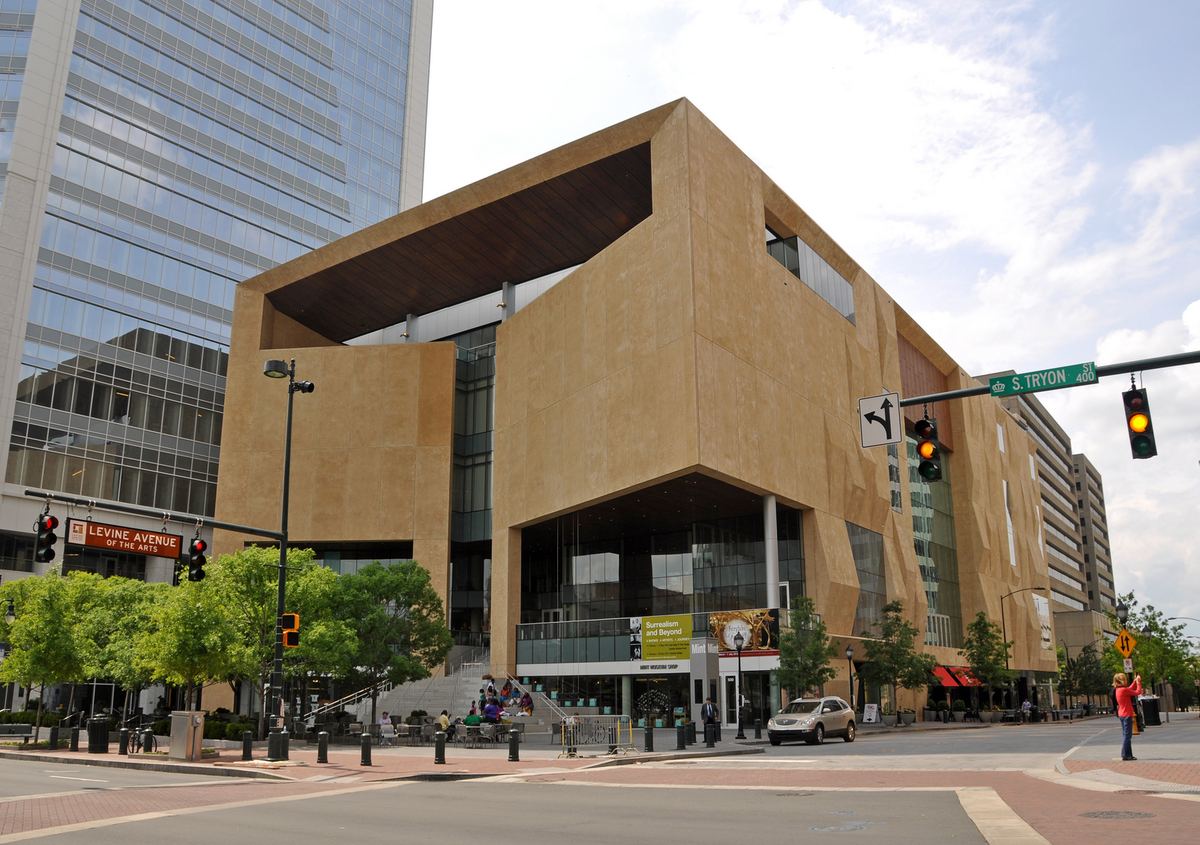
The former mint building, relocated, now holding the Mint's historic pottery and porcelain, art of the ancient Americas, and fashion collections.
Plan a visit: mintmuseum.org See also: Mint Museum Uptown and the Levine Center for the Arts
What we still don't know
We would rather say this than fill it in:
- The Rudisill Gold Mine. Named as Charlotte's principal in-city mine, but we have no primary source for where exactly it was, when it worked, or what it produced.
- The Bechtler mint at Rutherfordton. Named in our sources as the origin of the privately struck coins that preceded the federal mint — not yet researched.
- Mecklenburg Iron Works, which built the stamp mill that ended Reed's last chapter. A Charlotte industrial story we have not followed.
- The mint's own 1836–1913 working life. Our best source for that period is a general reference work, and we want better before we write it.
Sources: North Carolina Department of Natural and Cultural Resources, Reed Gold Mine history page (S-0762, accessed 2026-09-14) for the Reed narrative; The Mint Museum's own history and Land and Labor Acknowledgement (S-0781, accessed 2026-09-14); the Charlotte-Mecklenburg Historic Landmarks Commission survey report quoting Thomas Hanchett (S-0730); and, for the branch mint, mine count and Rudisill attribution, a general reference work (S-0760) flagged in the text as unverified. Hours and admission are not republished; every visiting link goes to the operator.
Places on this page, in detail
- Community · public art
- Connections · public art
- Industry · public art
- Mint Museum Randolph · museums
- Mint Museum Uptown · museums
Read next
Local landmark or National Register? What the labels actually mean
If you have looked into an old Charlotte building you will have met both phrases, often on the same…
Who designed Charlotte: the planned suburbs
Drive through Dilworth, Myers Park or Elizabeth and the streets curve where a developer working to a…
Dilworth
Dilworth was laid out for Edward Dilworth Latta, and it kept his middle name. The National Register of…
NoDa (North Charlotte)
NoDa is short for North Davidson, the street it grew up along. The name is recent; the place is not. On…
The Historic West End
West of Uptown, around the campus of Johnson C. Smith University, is a network of neighbourhoods that…
University City
Charlotte's north-eastern quarter is organised around a university, a boulevard and a rail line, and…