In this guide
Make two decisions before buying: whether you want the racing simulators, and whether your chosen date gives you enough time to enjoy the museum. Then check the current entrance notice, because renovations have changed the pedestrian approach.
Know before you go
The street address is 400 East Martin Luther King Jr. Boulevard, Charlotte, NC 28202. During renovations, the Hall directs visitors to a temporary entrance off South Caldwell Street. Follow the current signs from surrounding sidewalks and garages. The operator expects the work to finish in summer 2027 and says the museum and exhibit experiences remain open. Current renovation notice
As checked Oct 4, 2026, the regular museum schedule is 10 a.m.-5 p.m. on Monday and Wednesday through Sunday, with Tuesday closed. Check the official visitor page for your date before arranging the rest of the day.
Planning recommendation: Set aside roughly two to three hours for a first visit, with more time if you want repeated simulator sessions or to read extensively. This is a planning allowance, not a minimum stay or a guarantee about queues. If you have a tight departure, pick your priorities at the start instead of leaving the simulator until the last few minutes.
Which ticket should you choose
Posted admission prices in U.S. dollars, checked Oct 4, 2026:
| Visitor | Listed admission | After the stated $2 online reduction |
|---|---|---|
| Adult, age 13 and over | $29 | $27 |
| Senior, 65 and over with valid ID | $26 | $24 |
| Youth, ages 4-12 | $22 | $20 |
| Child under four | Free | Free |
Applicable service fees can change the amount paid. General admission covers exhibits and interactives except the racing simulator. Buy a simulator add-on or a package only if your group wants that experience. The Starting Grid package lists admission, a simulator day pass and a lanyard at $38, or $36 online. Official prices and package inclusions
A single simulator experience can also be bought at the box office, but the current published visitor page did not establish a verified single-ride price for this guide. Ask before upgrading. An all-day simulator pass is most useful when you plan repeated sessions; it need not be the default purchase for a history-focused visit.
For budget planning, two adults and two children ages 4-12 total $102 at the listed admission prices or $94 after the stated online reductions, before service fees. Add transport or parking, food and any simulator upgrades. This is straightforward arithmetic from posted rates, not a final checkout quote.
For a near-term family visit, the Hall has announced Kids Go Free on October 24–25, 2026: up to two complimentary youth admissions per paid adult general-admission ticket, redeemed at the box office rather than online. Check the full event terms before choosing between that offer and ordinary online admission. This is a dated promotion, not a standing free-entry policy.
What to see and do inside
The Hall opened on May 11, 2010 to interpret NASCAR's history and heritage. Its collection includes artifacts, hands-on exhibits, a theater and the Hall of Honor. About the Hall
For a first visit, think in three themes:
| What interests you | Start here | How to approach it |
|---|---|---|
| Cars, design and racing history | Glory Road, Heritage Speedway and Hall of Honor | Pick a car or person to follow rather than trying to absorb every label |
| Engineering and hands-on activities | Inside NASCAR and Pit Crew Challenge | Compare how a car works with what the crew has to do under pressure |
| Competition and game-like experiences | Racing simulators and broadcasting activities | Decide on simulator spending separately and leave time for turns |
The current Glory Road installation focuses on team owners. Other listed displays include Team Penske, Earnhardt racing history and Hall of Honor. Exhibitions change, so use the current exhibit list if one car, driver or team is the reason for your visit.
The interactive areas give non-fans useful ways into the subject: see how an engine works, examine a virtual race car, try announcing a race or take on pit-crew tasks. Those choices make a more concrete plan than simply deciding whether you are a NASCAR person.
The High Octane Theater provides a seated introduction to the sport's development. Consider starting there if you would like some context before the cars and memorabilia. For someone who already follows the sport, starting with a particular exhibit may be the more satisfying route. Follow staff directions where construction changes circulation.
Families and simulator expectations
The simulator's published height threshold is 54 inches, with a parent-lap exception for smaller children. Confirm with staff how that applies to your child before purchasing specifically for the simulator; a lap experience is a different expectation from independently driving. Simulator information
For younger visitors, keep a short list of hands-on stops and allow a break. The Hall also advertises a life-size Lightning McQueen near the Hall of Honor, which may be a useful point of interest for a Cars fan; check the current explore page rather than promising a permanent display.
Children under seventeen need a chaperone aged eighteen or older. An adult-priced admission for a teenager does not mean they can visit unaccompanied. The venue also lists a nursing room; ask Guest Services where to find it during the current construction phase. Family and ticket policies
School-age children who enjoy mechanisms, cars or timed challenges have clear options here. For a toddler-centered outing, compare the activities your child would actually use before committing the whole family's budget. A museum built around racing history is a different experience from a general indoor play space.
Parking, light rail and the temporary entrance
The visitor garage entrance is at 500 South Brevard Street. The operator lists a $25 daily maximum, with rates subject to events; ordinary museum tickets do not validate parking. A separate surface lot at 501 South Caldwell Street lists $15 daily parking, subject to space and with no overnight parking. Garage clearance is 7 feet 6 inches. Oversized parking is limited and requires a reservation. Parking details
Use the garage address for the car and the renovation notice for the current pedestrian entrance. A reference to Caldwell Street in the temporary visitor directions does not mean the garage's Caldwell entrance is available to ordinary visitors; the Hall identifies that garage entrance as monthly-parking access.
If you are comparing parking choices, consider your expected stay and the day's posted event rate. The surface lot's published flat rate may suit a longer visit, but neither listed price guarantees availability. A tall van, roof box or oversized vehicle requires more checking than a standard car.
For rail, CATS lists 3rd Street Station at 305 East 3rd Street and identifies a wheelchair-accessible platform. Check the onward walk to the temporary entrance and current service information. Station accessibility does not, by itself, confirm the condition of every sidewalk or construction detour. The Charlotte getting-around guide helps with the wider journey.
Accessibility and a comfortable visit
The Hall publishes several specific accommodations: elevators, wheelchair seating in the theater, a wheelchair-accessible simulator and a limited supply of courtesy wheelchairs. Courtesy chairs are first come, first served and require photo ID. Most video presentations are open-captioned; sign-language interpretation should be requested two weeks ahead and depends on availability. Accessibility details
The alternate banking experience has a transfer limitation: staff cannot transfer a visitor from a wheelchair to the unit. Discuss assistance needs beforehand if that experience matters to you. Avoid treating one accessible simulator or elevator as proof that every experience works the same way for every visitor.
The Hall also identifies itself as a KultureCity sensory-inclusive venue and offers sensory kits at Guest Services. Visitor services Before a visit affected by noise, walking distance or mobility, call 888-902-6463 to ask about the temporary entrance, current accessible route, available equipment and quieter options. Construction may make arrival different from descriptions written before the work began.
Food and breaks
Plan a café stop or a meal before or after the museum rather than packing a picnic for the galleries. The Hall's policy excludes outside food and drinks, and the café remains open during the renovation according to the current construction notice. Check visitor policies or ask ahead if a specific food need affects the visit.
The operator permits same-day re-entry with the ticket. Keep it accessible if you step out for a break, and confirm the day's closing time before leaving. Do not assume a brief exit extends admission to a different date.
The building and its public art
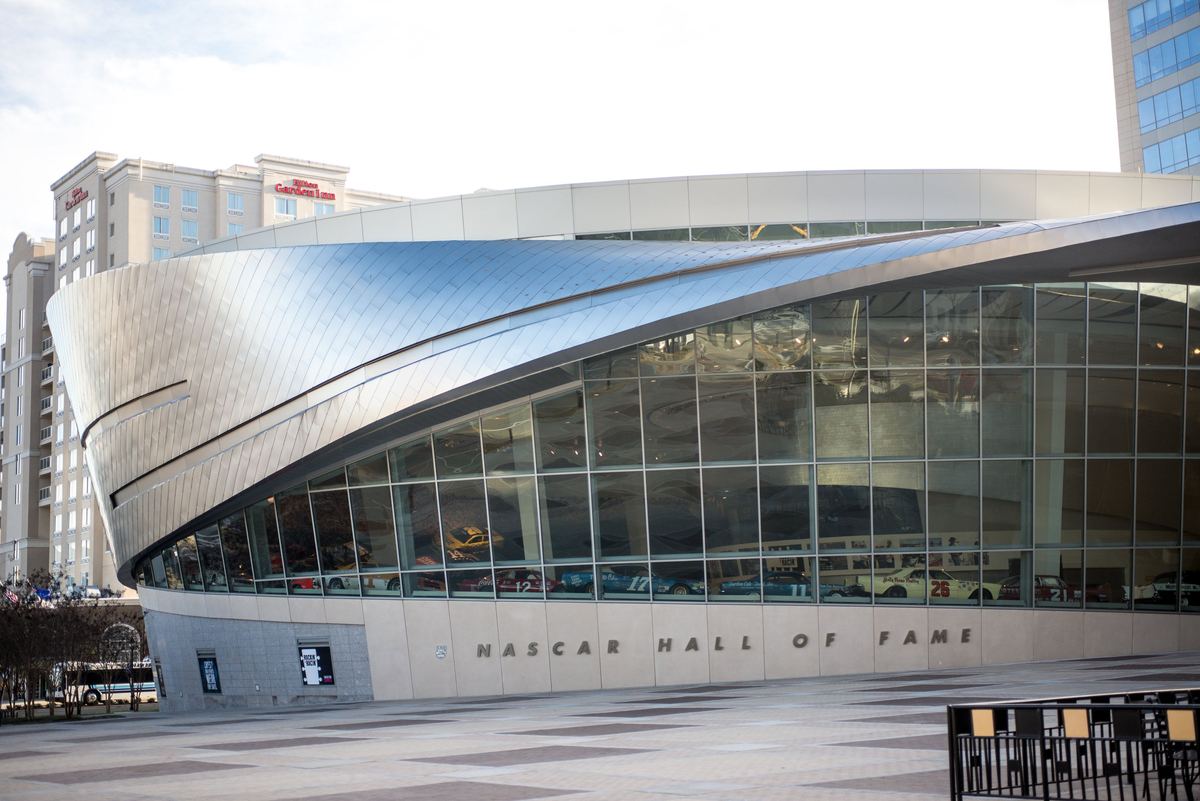
Before or after the museum, look at how the building's exterior bends around the site. Pei Cobb Freed & Partners describes a metal ribbon that twists over the entrance, while a banked interior ramp displays race cars. The design deliberately connects the building's shape with the movement of racing. Architect's project account
The county-hosted public-art register records four exterior computerized-light works at the Hall: Elementary Particles and Wipe by Erwin Redl, and Glory Road and Racing to Get In by Norman Coates. These are recorded artworks, not a guarantee that a lighting program will be operating during your visit. Public-art register
Use the Handbook's public art at NASCAR Hall of Fame directory to identify them. The exterior artwork called Glory Road is a separate entry from the indoor race-car exhibition with the same name. Stay outside construction barriers and keep the art stop flexible.
Fit it into an Uptown day
Make the museum your main indoor stop, then choose one nearby or thematic addition based on your interests and remaining energy. Read Brooklyn and urban renewal for deeper neighborhood context, or compare the museums in Levine Center for the Arts if you are deciding between different kinds of cultural visits.
For a rainy or very hot day, indoor galleries make the Hall an option worth comparing, but the journey from parking or rail still requires an outdoor approach. Check the rainy-day guide if your party would rather spend its time on science, art or another subject.
Frequently asked questions
Do I need to be a racing fan? No prior knowledge is needed to choose engineering and interactive stops. Enjoyment still depends on your interests; browse the linked exhibits rather than assuming every indoor museum will suit your group equally well.
Are racing simulators included? They are excluded from ordinary admission. Compare an add-on with a simulator package, and check the height guidance before making it the reason for your visit. Tickets
Is the museum closed during renovations? The operator says it remains open, with a temporary South Caldwell Street entrance and adjusted pathways. Check the renovation page close to your visit.
Can I bring a pet? Pets are not permitted inside; the Hall allows service animals under its published policy. Accessibility and service-animal information
Can I get a refund if plans change? The Hall says refunds are at management's discretion. Do not treat an admission purchase as automatically refundable; review the ticket FAQ before buying.
Can I just look at the building? An exterior architecture stop is separate from paid museum admission. Current construction and barriers may affect where you can walk or take photographs; follow the posted route.
Sources and review
Reviewed Oct 4, 2026 using the Hall's visitor, renovation, exhibit and accessibility pages, CATS, the architect and the county public-art register. Posted prices are dated planning figures, not a verified checkout total. The guide is based on public sources and does not claim a firsthand test of exhibits, construction routes or accessibility.
Places on this page, in detail
- Elementary Particles · public art
- Glory Road · public art
- Racing to Get In · public art
- NASCAR Hall of Fame · museums
Read next
Charlotte public art: where to start and what is in the register
Mecklenburg County’s public art register lists 242 installations…” with:
Charlotte Motor Speedway in Concord: Tours, race parking and gates
Start with the venue named on your ticket. The Charlotte Motor Speedway complex in Concord includes the main speedway, zMAX Dragway and The Dirt Track at Charlotte. The operator gives separate driving and parking directions for each. Share the full venue and lot name with everyone meeting you. Official parking and directions · Facility maps
Charlotte on a rainy day
For an easy indoor start, choose a library visit or one museum. For swimming or a recreation-center activity, find the actual public session before traveling. A building marked as indoor on a map is not necessarily open for a drop-in visit.
Bechtler Museum of Modern Art
Most museum collections are assembled. This one was lived with.
Camp North End Charlotte: Parking, food and things to do
Camp North End is a former industrial campus in north Charlotte with shops, places to eat, outdoor gathering spaces and events. Start with a storefront, an exhibition or an event. A named venue makes a better meeting point than the campus name alone. Camp North End visit guide · Campus directory
Carowinds: Plan Your Visit
Plan a Carowinds day around the rides your group wants, the ticket that covers your visit and the seasonal experiences operating on your date. Check individual ride requirements before buying, especially when children or access needs will shape the day.